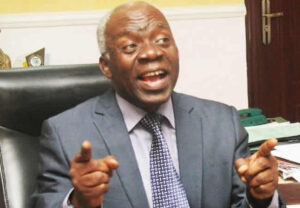


Civil rights activist and Executive Director of the International Society for Civil Liberties and Rule of Law (Intersociety), Mr. Emeka Umeagbalasi, has strongly refuted claims credited to the New York Times suggesting that his organisation admitted to not verifying its data on alleged genocide in Nigeria.
Speaking on Monday during Prime Time, a current affairs programme on Arise Television, Umeagbalasi described the report as misleading and a misrepresentation of facts presented to the international media organisation.
He maintained that Intersociety never conceded to any failure in data verification, stressing that such an assertion fundamentally undermines the credibility of the organisation’s work and the rationale for engaging the New York Times in the first place.
According to him, the claim that Intersociety does not often verify its data was neither stated nor implied during interactions with the newspaper, adding that the report selectively presented information and, in his words, was “economical with the truth.”
Umeagbalasi clarified that Intersociety’s findings were clearly outlined in its report, which affirmed that both Christians and Muslims enjoy religious freedom in Nigeria, while also documenting cases of religiously motivated violence over the years.
He explained that the organisation’s data estimates that between 2009 and 2025, no fewer than 125,000 Christians and about 60,000 Muslims were killed by Islamic jihadist groups, noting that these figures were distinct from official government statistics.
The activist emphasised that Intersociety was not relying on figures attributed to the National Bureau of Statistics, which reportedly linked hundreds of thousands of deaths to general insecurity within a shorter period. Rather, he said the organisation’s focus was strictly on killings driven by religious extremism.
“You cannot be part of a data set you did not generate,” Umeagbalasi asserted, underscoring that the figures in question were independently compiled by Intersociety through its own methodology.
Drawing from his background in criminology, he further argued that circumstantial evidence remains a cornerstone of criminal justice administration globally, noting that investigators often rely on credible accounts and patterns, even when they were not physically present at the scene of crimes.
The comments add a new layer to the ongoing debate surrounding data credibility, international reporting and the sensitive issue of religiously motivated violence in Nigeria, with Umeagbalasi insisting that accuracy and context must not be sacrificed in global narratives.