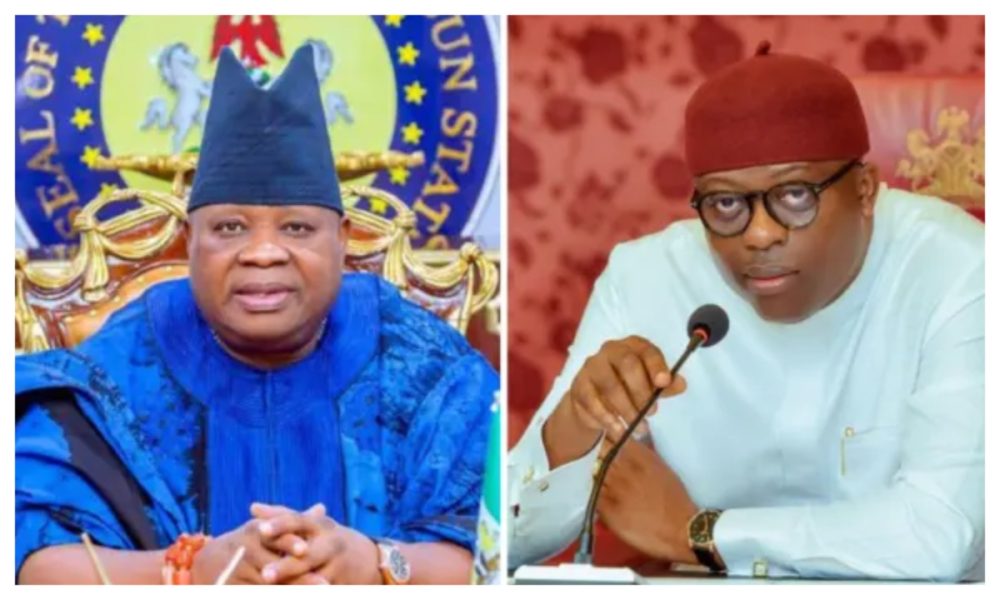

Nigeria’s opposition landscape slipped further into uncertainty yesterday as Governors Siminalayi Fubara of Rivers State and Ademola Adeleke of Osun State formally severed ties with the Peoples Democratic Party, PDP, heightening concerns over the party’s stability ahead of the 2027 general election.
The double exit, delivered within hours of each other, has intensified the strain on a party already battling internal fractures, waning influence and a wave of defections that has tilted the political balance sharply toward the ruling All Progressives Congress, APC.
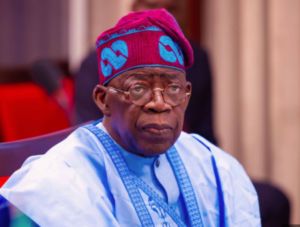
Fubara, speaking before party leaders and allies at Government House, Port Harcourt, declared his alignment with the APC, insisting the PDP offered him “no protection” amid the fierce political turbulence that has engulfed Rivers State in recent months. With confidence and defiance, he told supporters that his next political chapter must be anchored in open identification with President Bola Ahmed Tinubu’s leadership.
“We have the people, we have the supporters,” he said, adding that his full backing for the President could not come from the shadows. His declaration follows the defection of Speaker Martin Amaewhule and 17 other lawmakers, all citing unresolved crises within the PDP.
In Osun, Governor Ademola Adeleke confirmed his switch to the Accord Party, revealing he had quietly joined the platform in early November as part of his preparations for a re-election bid next August. In a message to residents, he framed the move as an ideological realignment, contending that Accord’s “welfarist mission” mirrors his governance agenda.
The departures come at a delicate moment for the PDP, which has witnessed a steady erosion of its ranks since the 2023 polls. With governors, senators and other high-profile figures drifting toward the APC, political observers warn the trend could usher in a creeping one-party order—an outcome analysts say could undermine Nigeria’s democratic competitiveness.
In a swift and sharp reaction, the PDP national leadership absolved itself of blame, arguing that Governor Fubara’s actions were self-engineered. The party’s National Publicity Secretary, Ini Ememobong, said the governor’s narrative of abandonment was misplaced, insisting the PDP and civil society actors had repeatedly defended him at critical moments.
“He willingly travelled the path that took him to this destination,” the statement read, adding that Fubara’s exit feeds a troubling march toward a one-party state.
Political experts say the defections expose deeper ailments within the PDP beyond routine political reshuffling. Dr Nduka Odo, a public affairs analyst, described the situation as “a structural convulsion,” warning that the party’s internal cohesion has reached a precarious threshold.
According to him, Fubara’s move reflects a survival strategy amid entrenched hostilities in Rivers, while Adeleke’s shift signals exhaustion with chronic factionalism.
“What we are witnessing is not the usual season of defections,” Odo explained, stressing that the PDP’s internal reward system and conflict-resolution mechanisms appear to have collapsed. He, however, maintained that recovery remains possible if the party undertakes drastic reforms and renegotiates power with its stakeholders.