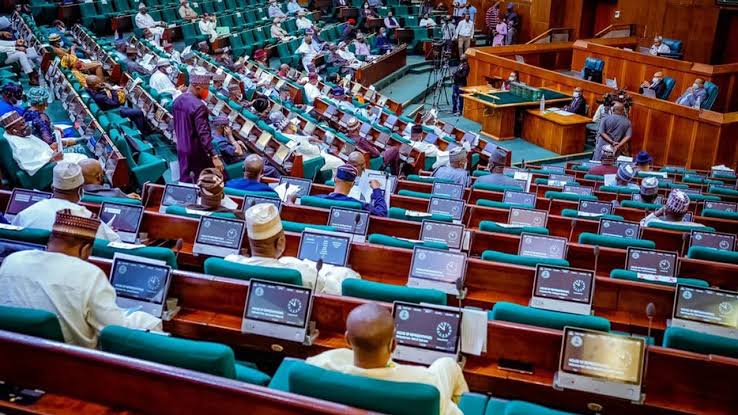

A coalition of 44 members of the House of Representatives has appealed to President Bola Tinubu to adopt a political settlement in the long-running case involving the detained leader of the Indigenous People of Biafra, Nnamdi Kanu.
The lawmakers, operating under the banner of the Concerned Federal Lawmakers for National Unity, submitted a two-page letter and a formal resolution to the President, urging him to deploy his constitutional authority to end Kanu’s prosecution and initiate a broad national dialogue aimed at restoring calm to the South-East.
The group, comprising legislators from both northern and southern blocs, argued that years of judicial confrontation had not eased insecurity or quelled separatist agitations in the region. Instead, they maintained that a structured political engagement remained the most effective pathway to de-escalation.
Their letter urged the President to direct the Attorney-General of the Federation to discontinue the Federal Government’s case against Kanu, citing domestic court decisions and international tribunal pronouncements recommending his release.
The document bore the signatures of Ikenga Ugochinyere, Obi Aguocha, Murphy Osaro, Peter Akpanke, and Mudashiru Lukman, alongside other members including Paul Nnamechi, Dominic Okafor, Afam Ogene, Emeka Chinedu, Chimaobi Sam, Mascot Ikwechegh, Donatus Matthew, Ibe Osonwa, and Okey-Joe Onuakalusi.
“Motivated by the urgent need for national healing and reconciliation, and mindful of escalating insecurity in the South-East since 2015 — worsening from 2021 — we believe the time is ripe for a decisive political approach,” the lawmakers wrote.
They emphasised that the Federal Government had previously engaged in negotiations with militant and agitator groups, arguing that a similar approach could help stabilise the region and diffuse longstanding grievances.
The legislators expressed confidence that President Tinubu would give their request “serious and favourable consideration,” stressing their commitment to supporting national cohesion, security reforms and efforts to reinforce unity.
Kanu, first arrested in 2015 on charges bordering on treasonable felony, was granted bail in 2017 but fled the country after a military operation at his Abia residence — a move IPOB claims was an assassination attempt. He resurfaced abroad and resumed separatist broadcasts until his interception in Kenya in June 2021 and subsequent return to Nigeria.
His re-arrest triggered heightened agitation in the South-East, marked by prolonged sit-at-home orders and targeted attacks linked to IPOB elements. His nearly decade-long trial is now approaching a conclusion, with the Federal High Court in Abuja scheduled to deliver judgment on February 20, 2025, after he declined to open his defence.
Meanwhile, President Tinubu, receiving a delegation of the Duke of Edinburgh’s International Award Foundation in Lagos, reiterated his administration’s commitment to youth development, security reform and economic transformation. He highlighted investments in fibre-optic networks and digital infrastructure as part of broader initiatives to expand opportunities for young Nigerians.
Minister of Finance and Coordinating Minister of the Economy, Wale Edun, noted that Nigeria’s median age of 17 continued to shape policy choices, particularly those geared towards skills development and economic participation.
The Duke of Edinburgh’s International Award Foundation Chairman, Prince Edward, commended the administration’s reforms, describing them as initiatives that had attracted global goodwill. He announced that 320 young Nigerians would be honoured for excellence and leadership during the Foundation’s Lagos Award events.
Also present were the British High Commissioner, Sir Richard Montgomery; the Duke’s Private Secretary, Alex Potts; the Award’s Secretary-General, Martin Houghton-Brown; and International Trustee and Africa Region Chair, Muhoho Kenyatta.