
…Unveils Criminal Database To Tackle Missing Files
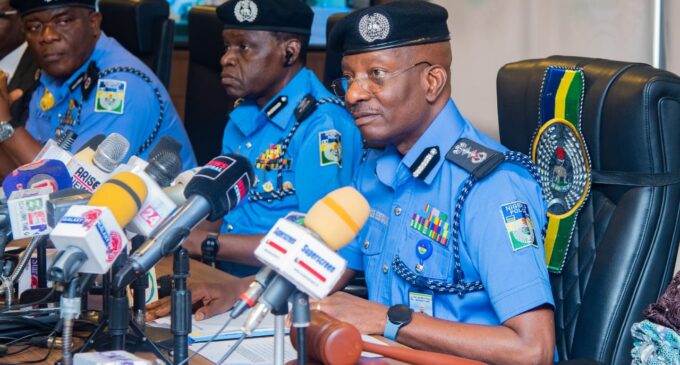
The Inspector-General of Police, Kayode Egbetokun, has warned officers of the Nigeria Police Force (NPF) against interfering in land matters and other civil disputes, stressing that the Force is not a tool for private enforcement.
In a video statement shared on the Force’s X handle on Thursday, the police chief cautioned that any officer caught escorting parties in land recovery exercises or meddling in civil matters without a criminal element would face disciplinary sanctions.
Egbetokun said:
“The Nigeria Police is not and will never be an enforcer for private business. Officers have no business escorting parties for land recovery or disrupting legally existing occupations. Every such incident erodes the neutrality of the Force and exposes us to disrepute. Any officer who crosses the line will be dealt with.”
The IGP also rolled out a new Criminal Database System to modernise policing and address the recurring problem of missing files in investigations and prosecutions.
Speaking at the launch of a nationwide training session for operatives in Abuja, he described the initiative as a game-changer, marking a transition from reactive policing to data-driven and intelligence-led operations.
He said:
“This training is not just an exercise; it is a declaration that Nigerian policing has stepped into a new era. Without data, there is no memory. Without memory, there is no justice. But with data, there will be no hiding place for criminals.”
Egbetokun lamented that weak record-keeping and fragmented intelligence had for decades hampered policing in Nigeria, leading to stalled prosecutions, abandoned cases, and loss of public trust.
“With this new system, every arrest will be recorded, every case will be documented, and no file will simply vanish into thin air. Accuracy and diligence from our officers will determine whether criminals walk free or justice is served,” he said.
The police boss added that the platform would integrate with international policing networks, including INTERPOL and the African Union Border Programme, to ensure offenders could not escape accountability abroad.
“When a trafficker is convicted here, the world must know. When a weapon is seized at our borders, its trail must echo across continents,” he declared.
Egbetokun tasked officers undergoing the training to treat their roles with utmost seriousness, noting that they would serve as custodians of the nation’s crime data at all levels of the Force.
“You are not merely handling files; you are safeguarding Nigeria’s future,” he charged.